Evaluating the Life Better Beach Ocean Graphic for Creative Projects
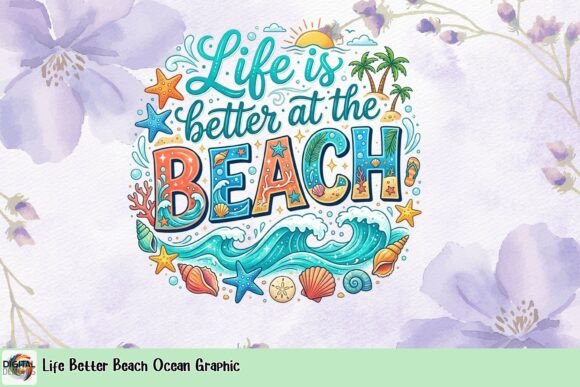
Selecting the right visual asset is a critical step in product development and digital design. For creators focusing on coastal aesthetics, summer merchandise, or ocean-themed branding, the Life Better Beach Ocean Graphic presents a specific stylistic option worth evaluating. This digital asset is a high-resolution PNG featuring a hand-drawn illustration of beach elements, including seashells, starfish, palm trees, and ocean waves, accompanied by playful typography stating "Life is Better at the Beach." Understanding the technical specifications, aesthetic applications, and practical limitations of this graphic allows designers and business owners to determine if it aligns with their current project requirements.
Defining the Asset and Its Visual Characteristics
The Life Better Beach Ocean Graphic is categorized as a raster image file in PNG format with a transparent background. Unlike vector graphics, which are mathematically generated and infinitely scalable, this asset relies on pixel density. The design style is intentionally illustrative and hand-drawn, distinguishing it from minimalist line art or photorealistic stock imagery. The color palette utilizes bright, saturated tones intended to evoke relaxation and warmth, while the typography integrates directly with the illustrative elements rather than sitting as a separate text layer.
For users evaluating this graphic, it is important to note that the composition is pre-arranged. The relationship between the text and the icons is fixed. This differs from modular design kits where individual elements can be repositioned. The transparency of the background facilitates easy layering over colored substrates or other digital backgrounds, but it also means the white space within the design is non-existent; the image boundary is defined strictly by the outermost pixels of the artwork.
Primary Use Cases and Application Fit
This graphic serves specific niches within the print-on-demand and crafting communities. Evaluating whether it fits your needs requires matching its attributes to your intended output method.
Sublimation and Heat Transfer
The most common application for this type of PNG is sublimation printing and heat transfer vinyl (HTV) projects. Because the file includes vibrant colors and complex shading, it is optimized for dye-sublimation processes where ink is infused into polyester fibers or polymer-coated surfaces. The transparent background eliminates the need for contour cutting, making it efficient for producing t-shirts, tote bags, and mugs. If your production workflow relies heavily on sublimation, this graphic offers a ready-to-print solution that reduces preparation time.
Seasonal and Thematic Merchandise
Retailers and creators targeting the summer season or coastal tourism market may find this asset relevant. The imagery is universally recognizable as beach-related without being tied to a specific geographic location. This makes it suitable for general resort wear, surf shop inventory, or vacation rental welcome gifts. However, because the design is distinctively colorful and playful, it may not align with luxury or high-end minimalist branding strategies that favor muted tones and abstract forms.
Digital Content Creation
Beyond physical products, the graphic functions as an overlay for social media posts, blog headers, or digital invitations. The transparent background allows for integration into various layouts. Users should verify the pixel dimensions before committing to digital use; while sufficient for web display, the resolution must be adequate to prevent pixelation on high-density screens.
Technical Considerations and Tradeoffs
When comparing the Life Better Beach Ocean Graphic against other design options, several technical tradeoffs influence decision-making. Acknowledging these factors helps manage expectations regarding print quality and editing flexibility.
- Raster vs. Vector Limitations: As a PNG, this graphic has a maximum effective size determined by its DPI (dots per inch). Enlarging the image beyond its native resolution will result in blurriness or jagged edges. If you intend to print on large-format items like beach towels or banners, you must confirm the file’s dimensions support that scale. Vector alternatives would be superior for large-format needs but may lack this specific hand-drawn texture.
- Editability Constraints: The text and illustrations are flattened into a single layer. You cannot change the font, correct spelling, move the starfish, or alter the color of the palm trees without advanced photo-editing skills. If customization is a priority, this asset may be too restrictive. Designers requiring editable text layers should seek PSD or AI files instead.
- Color Profile Compatibility: Digital PNGs typically utilize the RGB color space, while printers operate in CMYK. Bright, neon-like colors visible on screen may appear duller when printed. Users should anticipate a color shift and consider performing a test print or converting the color profile prior to mass production to ensure the output matches the vibrancy of the digital preview.
- Licensing and Exclusivity: Digital assets of this nature are often sold under personal or limited commercial licenses. Buyers must review the specific terms regarding resale, modification, and distribution. If brand exclusivity is essential, using a widely available stock graphic may pose a risk of market saturation, as other sellers may utilize the same design.
Situational Analysis: When to Choose Alternatives
While the Life Better Beach Ocean Graphic is a strong candidate for many projects, objective evaluation reveals scenarios where alternative solutions are more appropriate.
Choose a Vector Alternative If: You require infinite scalability for signage or vehicle wraps, or if you need to isolate individual elements for animation or composite layouts. Vectors also allow for effortless color matching to existing brand guidelines.
Choose a Custom Commission If: Your brand voice is sophisticated, understated, or requires specific messaging that differs from the pre-written slogan. A custom illustrator can replicate the hand-drawn feel while tailoring the content to your exact specifications and ensuring exclusive rights.
Choose a Text-Only Design If: You plan to apply the graphic to dark fabrics using standard vinyl cutters. Intricate, multi-colored PNGs cannot be cut from solid-color vinyl; they require printable vinyl or sublimation. Simple text designs offer greater versatility across different apparel decoration methods.
Decision-Making Framework for Buyers
To determine if this graphic supports your goals, apply the following practical checklist during your evaluation process:
- Verify Resolution Requirements: Measure your intended print area. Ensure the PNG provides at least 300 DPI at that physical size. Do not assume "high-quality" implies suitability for all sizes.
- Assess Substrate Compatibility: Confirm that your chosen decoration method (sublimation, DTF, DTG) supports full-color raster images. Avoid this file if you are restricted to single-color spot printing.
- Evaluate Brand Alignment: Compare the graphic’s color temperature and line weight against your existing product line. Consistency in visual language builds brand recognition; a mismatched graphic can dilute identity even if the theme is correct.
- Review License Scope: Document what you are permitted to do. If you plan to sell end products, ensure the license covers commercial sale of finished goods versus selling the digital file itself.
- Test Before Commitment: Print a sample on your actual substrate. Evaluate color accuracy, edge sharpness, and overall visual balance. Digital previews rarely capture the tactile reality of the final product.
The Life Better Beach Ocean Graphic offers a convenient, aesthetically cohesive solution for creators working within the coastal niche. Its value lies in its immediate usability for sublimation and its cheerful, accessible art style. However, its utility is bounded by the inherent constraints of raster graphics and fixed compositions. By carefully weighing these technical realities against project-specific needs, buyers can make an informed decision that balances creative vision with production feasibility. Ultimately, the suitability of this asset depends not just on its visual appeal, but on its compatibility with your manufacturing capabilities and brand strategy.